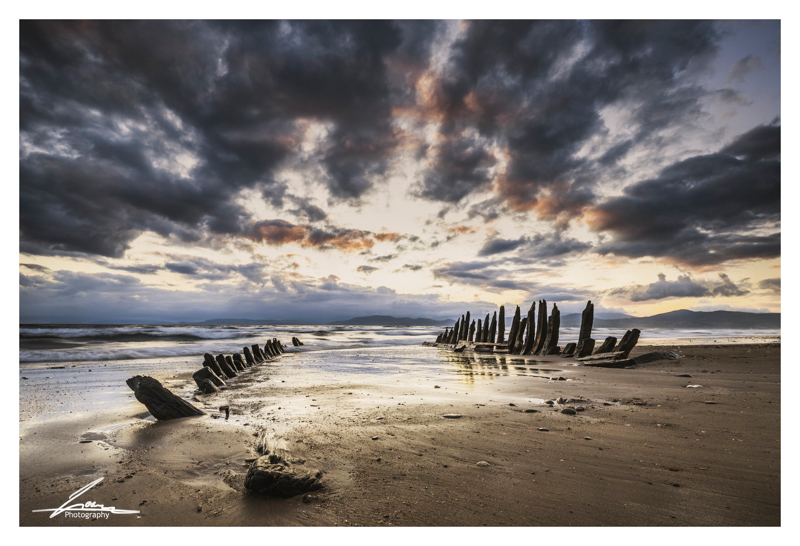
Shipwreck at Rossbeigh beach Co. Kerry Ireland
Shipwreck at Rossbeigh Beach Co. Kerry
On the golden sands of Rossbeigh Beach, the skeleton of a long-forgotten ship lies unveiled to the tides and time. This photograph captures the shipwreck not as mere decay, but as a monument — a reminder of the enduring dialogue between human history and the elemental forces of nature. Framed by a vast, turbulent sky, the wooden ribs of the wreck rise like a choir of voices from the past, resonating with the whispers of the sea and the silence of memory.
First Encounter
The composition arrests the viewer instantly. The skeletal remains stretch across the sand, each jagged timber thrust upward like fingers reaching for air. These bones of oak and iron are stark against the wet gleam of the beach, their shadows reflecting in tide pools. Above, the sky explodes with motion — clouds torn apart by light, shades of gray, blue, and amber weaving together in restless movement.
The first impression is one of drama, as though the beach itself is a stage where history and eternity perform their endless play.
Light and Atmosphere
The light in this photograph is its most haunting element. A break in the cloud allows rays of gold to spill across the sand, touching the shipwreck with an almost sacred illumination. The wreck is not presented as ruin alone, but as relic, imbued with dignity through light.
The wet sand mirrors the sky, doubling the drama of the clouds and heightening the sense of otherworldly atmosphere. The reflective surface transforms the beach into a liminal space — neither land nor sea, but something between, where memory and myth intermingle.
The Shipwreck as Symbol
A shipwreck is never just timber. It is memory embedded in landscape, a vessel transformed into narrative. In this image, the wreck stands as a dual symbol: of fragility in the face of nature, and of resilience against the tide of oblivion.
The skeletal form resembles the remains of some ancient creature, long buried and unearthed by shifting sands. This invokes a sense of archaeology, as though we are looking at an artifact not merely centuries old but primordial, bridging human history with geological time.
Temporal Layers
This photograph holds within it multiple timelines:
-
The Past — the ship in its prime, carrying lives, goods, and ambitions. Its story may be lost, yet its presence lingers.
-
The Present — the wreck as it is now, exposed on Rossbeigh Beach, reshaped by wind, tide, and sand.
-
The Future — the inevitability of disappearance, as wood rots and tides reclaim what remains.
Together, these timelines remind us of our own place within the vast continuum of time, where permanence is an illusion, and all things pass into memory.
Composition as Theatre
The photograph’s framing is masterful in guiding the viewer’s gaze. The wreck stretches diagonally, its jagged line leading us into the depth of the frame, toward the horizon where sea and sky collide. This diagonal energy contrasts with the vertical thrust of the timbers, creating a rhythm of movement that echoes the rolling sea and racing clouds.
The low perspective grounds us in the sand itself, placing us at the level of the wreck, almost as participants in its story rather than distant spectators.
Emotional Resonance
This is a work that resonates emotionally on many levels. For some, it may stir melancholy, a mourning for what is lost. For others, it may inspire awe at the resilience of the wreck, which still stands despite time’s attempt to erase it. For all, it evokes humility, confronting us with the scale of forces greater than ourselves: the sea, the wind, the passage of centuries.
The photograph is not only about ruin; it is also about beauty — the beauty of imperfection, the poetry of decay, the quiet majesty of endurance.
Artistic Technique
Technically, the image balances texture and tone with striking precision. The timbers are sharp, their jagged edges etched against the smooth reflection of sand and water. The clouds are rendered with depth, their sculptural volume reinforcing the sense of grandeur.
The color palette is restrained, dominated by earthy browns, grays, and muted golds, yet these tones harmonize perfectly with the theme of transience. The richness of texture — wood, sand, sky — allows the viewer to almost feel the roughness of the timbers and the dampness of the tide-washed beach.
The Universal in the Local
While this wreck belongs specifically to Rossbeigh Beach, the photograph transcends its setting. Shipwrecks appear in art and literature across cultures, always carrying with them themes of mortality, ambition, and nature’s dominion. Here, the Irish landscape lends its particular atmosphere — wild, raw, untamed — but the image speaks to a universal truth: all human journeys end, and all creations eventually return to the elements.
For the Collector
For collectors, this piece holds profound significance. It is not simply a seascape, but a meditation on time, memory, and resilience.
-
In a private collection, it offers a contemplative focal point, a work that reveals new depths with each viewing.
-
In a public exhibition, it serves as a powerful anchor, inviting conversations on heritage, nature, and the poetics of ruin.
-
In a corporate or institutional setting, it stands as a reminder of endurance and transformation, qualities as vital in business and culture as they are in art.
Closing Reflection
The Shipwreck at Rossbeigh Beach is more than a photograph — it is a meditation on impermanence and endurance, memory and forgetting. The wreck stands as both ruin and relic, a symbol of human endeavor undone yet still resonant. The sea and sky, ever-changing, remind us that nothing lasts — and yet, in art, moments such as this endure.
This work does not merely show us a wreck; it invites us to see beauty in transience, dignity in decay, and poetry in the silence between the tides.
More photos form Kerry area Here
My Instagram account Here
My Facebook account Here
Reviews
There are no reviews yet.